
Tutorials
Specific by default
The more specific your subject, the more a model falls back on the average. Retrieval (RAG) fixes that and the cool thing is it now no longer needs your files.
A model knows a great deal about the middle of things. It has read enormous amounts about what most people think about most subjects, and when you ask it about something broad it answers well. The further your subject sits from that middle, the less it has to draw on: a particular product in a particular market, a workflow only a few thousand people have, a category three years old. The answers stay coherent and plausible. They just get less particular, because the model is filling in from the average rather than from the specifics.
That's the criticism we hear most often, and it's a fair one: Synthetic Users can be too generalist. And it lands hardest exactly where you'd least want it to, on the narrow, specific, unfamiliar subjects that are usually the reason you're running research in the first place.
Retrieval (RAG) is how we fight it. Give a participant real material about your subject and it stops generalising, because it has something particular in front of it. Opinions come with reasons attached. Answers cite the thing rather than the category. This is what uploading documents to a study has always done, and it works.
The limitation was never the method. It was that the method needed your files.
The market report, the transcripts, the competitor teardown: you had to have them, and you had to upload them before any of it helped. So the studies that needed the specifics most, the ones in a category you've never worked in, were the studies where you had the least to bring.
Now the platform goes and finds that material itself. Before a single participant is written, it reads your study, works out what it needs to learn, searches the web, reads the pages it finds, and builds an evidence base from what it learned. Your participants are built from that, and they draw on it during the interview.
It's already on
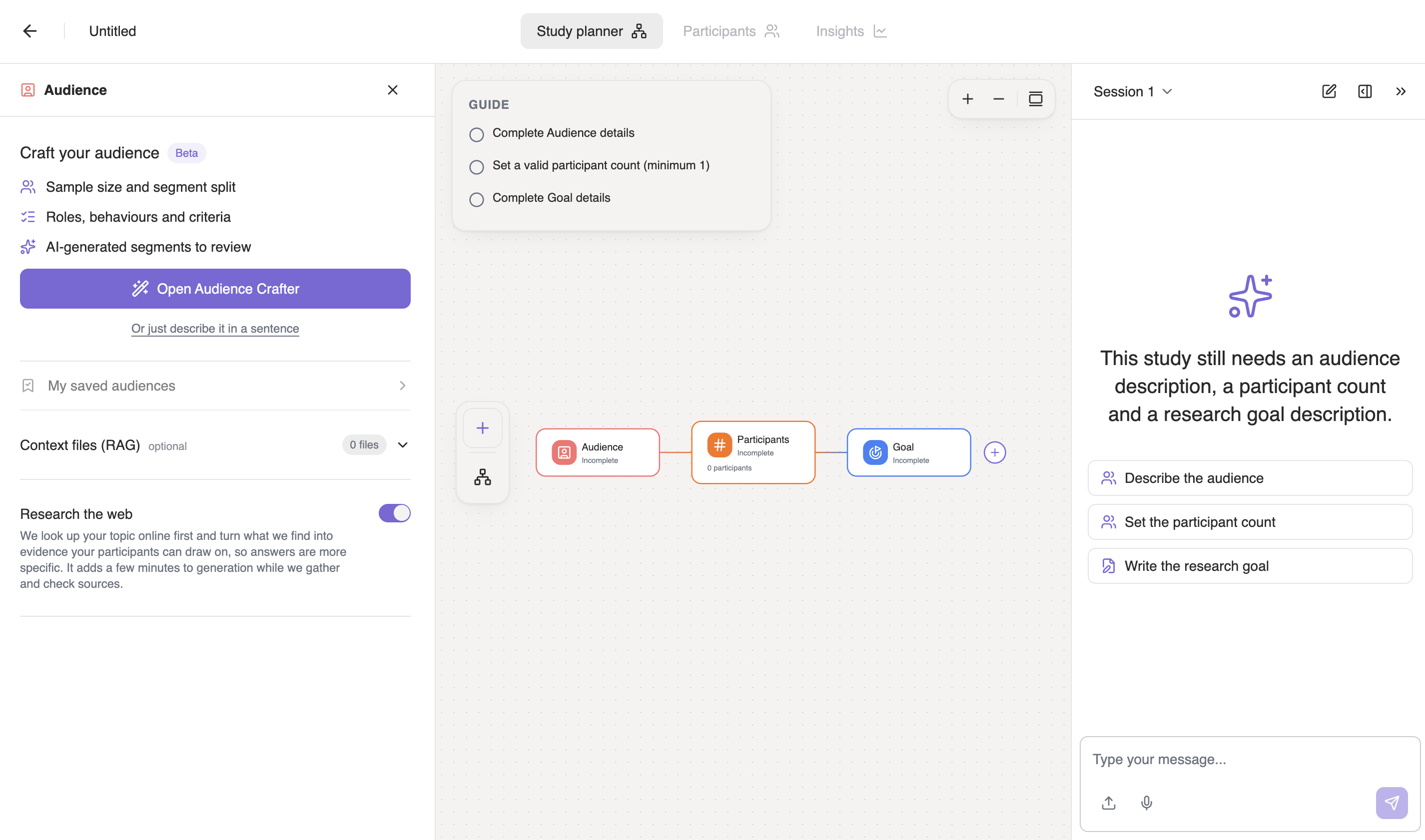
There's nothing to switch on and nothing new to fill in. Research runs by default, and it reads the study you've already described, your research goal, your concept, your audience. Set the study up exactly as you always have.
What you can do is turn it off. Research costs about five minutes, some studies are worth the wait and some aren't, so the switch sits per study rather than per project. One study can wait for grounded participants while the next one in the same project runs straight through.
Watch it work
When you generate participants, the research runs before they appear. It takes roughly five minutes, and it tells you where it is rather than leaving you on a spinner.
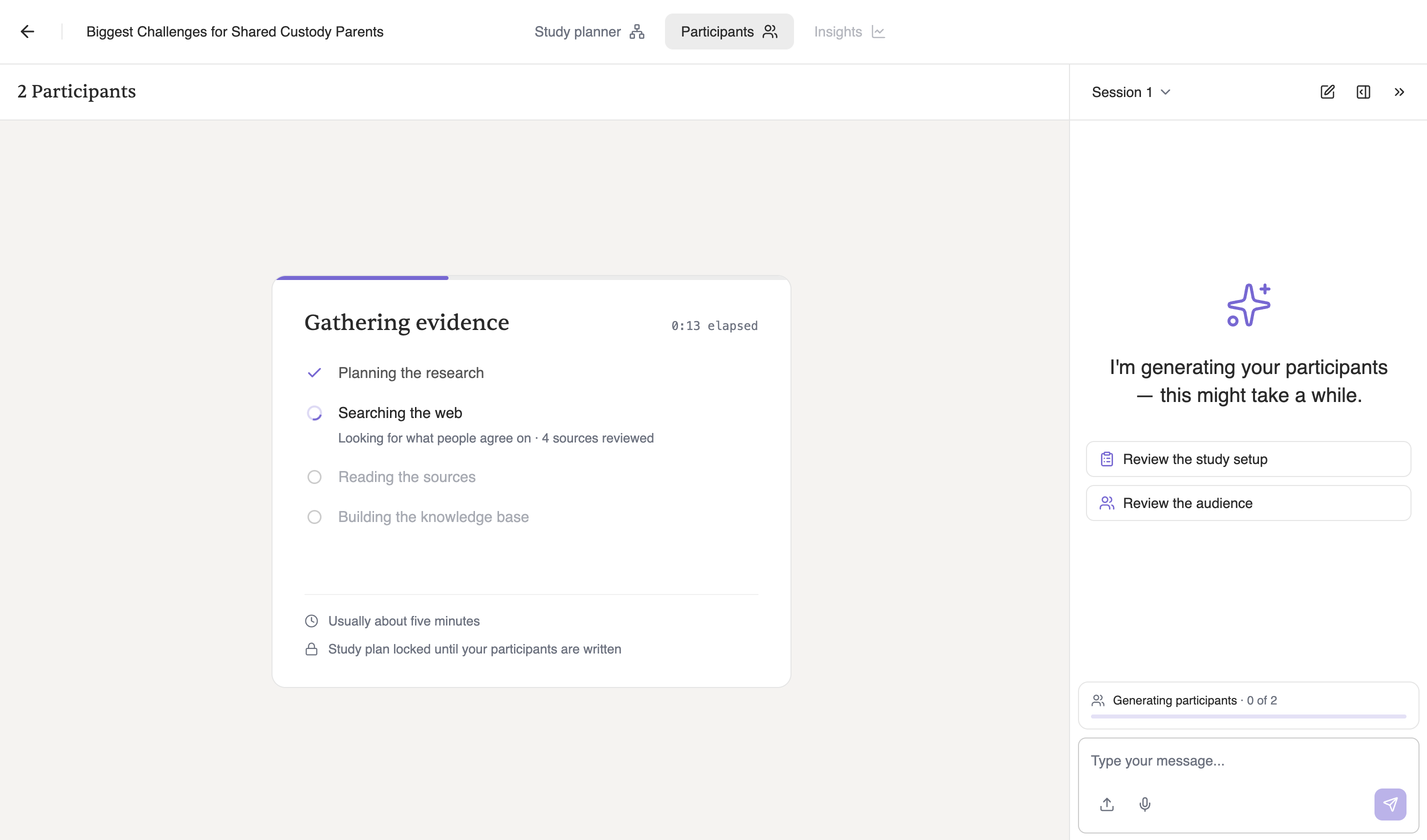
- Planning the research Naming the subject and picking what to search for. Everything downstream depends on getting the subject right, so this is its own step rather than something inferred from a single field.
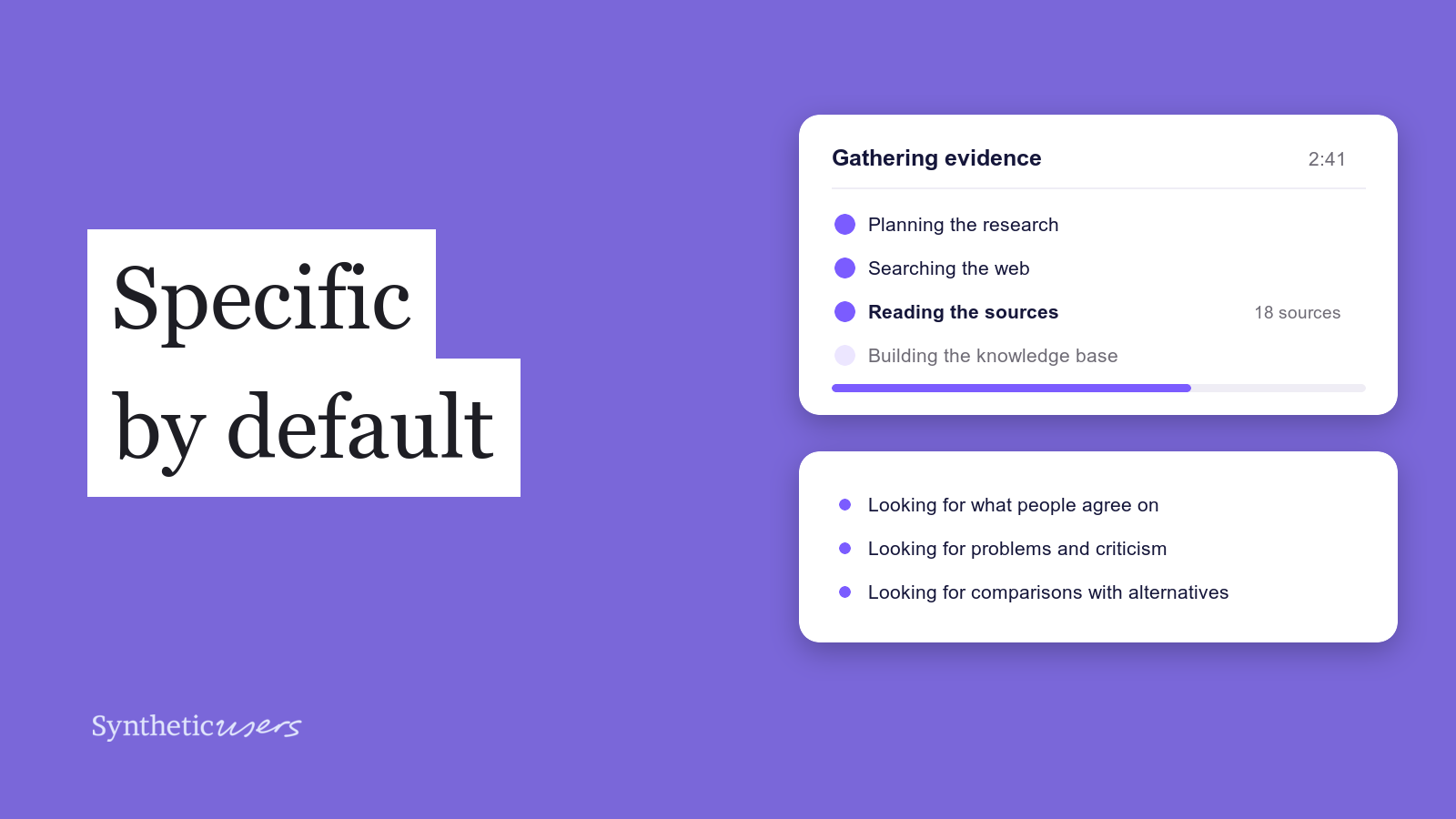
- Searching the web Running the planned searches. While it works it names what it's looking for: Looking for what people agree on, Looking for problems and criticism, Looking for comparisons with alternatives.
- Reading the sources Pulling out what each page actually says. Not what the model remembers about it, what the page says.
- Building the knowledge base Indexing what it learned so your participants can draw on it. Almost there, your participants are next.
When it finishes, the card ticks over to Evidence ready and your participants start appearing.
It goes looking for disagreement, on purpose
This is the part we'd most like you to notice.
A research agent left to search however it liked would come back with enthusiastic coverage. That's what the internet has most of, and that's what the obvious searches surface. Build participants from that and you get a room full of enthusiasts, individually believable and collectively wrong.
So looking for the unflattering material isn't optional here. The agent is required to search for criticism and for comparisons with alternatives, not only for what people agree on, and that requirement lives in ordinary code rather than in an instruction we hope the model follows. A model left to its own judgement will quietly skip the searches that spoil the story.
A note on the examples that follow: they're illustrative. No client material appears anywhere in this post.
Asked about a fitness subscription, the research came back with why people cancel, what the refund policy does to them, and three competing products that appear nowhere in the brief. Asked about on-call rotations, a subject surrounded by vendor marketing, it came back with three contrasts between different working practices and not a single vendor.
Every claim comes from a page we actually read
Nothing in the evidence base is written from the model's memory. Each claim carries the page it came from and the quote that supports it, and both are checked against what was actually downloaded. A quote that can't be matched to a page we really fetched is discarded rather than kept.
That check is deliberately boring code rather than a second model grading the first. Asking an AI to verify an AI reintroduces exactly the problem it's meant to catch.
It never blocks your study
If the search providers are unreachable, or the research comes back too thin to be worth anything, your study runs anyway, with participants written from your study plan, which is what you'd have had regardless. You'll see a note saying so rather than being left to wonder:
The research pass came back too thin to build a corpus, so your participants are written from the study plan alone. Everything else runs as normal.
Research is an improvement on the floor, never a new way for a study to fail.
How it works, briefly
For the curious. We decide what kinds of searches are required in plain code: how many must look for criticism, how many for comparisons, and no near-duplicates. The model chooses only the wording of each search. Then we read the pages, not the model's recollection of them. Keeping the requirements out of the model's hands is what makes the behaviour predictable on a subject none of us anticipated.
Every study, not just the ones with documents
The narrower and newer your subject, the more a Synthetic User benefits from having something real to read, and that has always been the case. What changes here is who gets that benefit. It used to be whoever happened to have the right documents on hand and the time to upload them. Now it's every study, including the ones where the whole point is that you're new to the subject and don't have the material yet.
If you do have your own documents, keep uploading them. Your proprietary material, your past transcripts, your internal research: none of that is on the web and none of it can be found by searching. Research the platform does for you sits underneath what you bring, it doesn't replace it. The two stack, and a study with both is the best-informed study you can run.
Every study now starts from something specific, rather than from the average.