
Science
Chain-of-feeling
Synthetic Users use a “chain-of-feeling” approach—combining emotional states with OCEAN personality traits—to produce more human-like, realistic user responses and yield richer UX insights.
Synthetic Users use a “chain-of-feeling” approach—combining emotional states with OCEAN personality traits—to produce more human-like, realistic user responses and yield richer UX insights.
Chain-of-feeling
To cut to the chase, a “chain-of-feeling” is essentially your synthetic user’s emotional narrative as they reason through a task. Just as a chain-of-thought ensures a more transparent cognitive process (something OpenAI introduced in O1, a chain-of-feeling ensures a more realistic, human-like emotional process—critical for generating diverse, nuanced insights in UX research.
If you’ve been to one of our webinars or demos you know how important the OCEAN personality model is in generating better Synthetic Users, i.e. Synthetic Users that when compared to organic users score considerably higher than going directly to a GPT.
The Chain-of-feeling method doubles down on a more visceral approach to UX research. As models migrate from a System 1 to a System 2, from instinct to rational explanation, we at Synthetic Users are doubling down on S1. We want our Synthetic Users to be as close or organic users (what you call real humans). Closer implies factoring in all the cognitive impairments and emotional drivers that influence users’ behaviour.
1. What Is a Chain-of-Feeling?
• Chain-of-thought: A stepwise cognitive reasoning sequence.
• Example (simplified):
1. I see a question.
2. I recall relevant data.
3. I reason through possible answers.
4. I synthesize and present a final solution.
• Chain-of-feeling: A parallel or intertwined emotional sequence.
• Example (simplified):
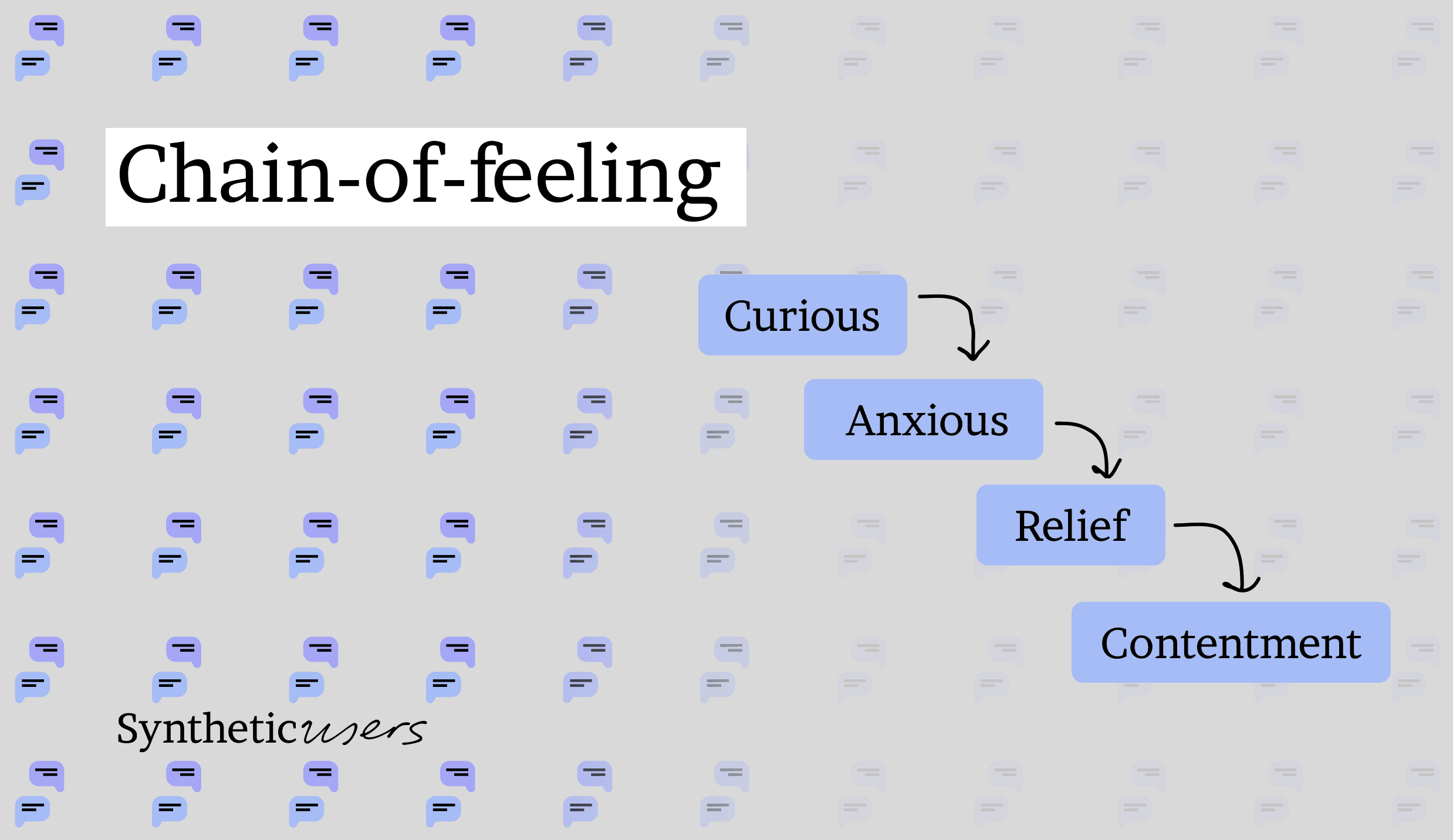
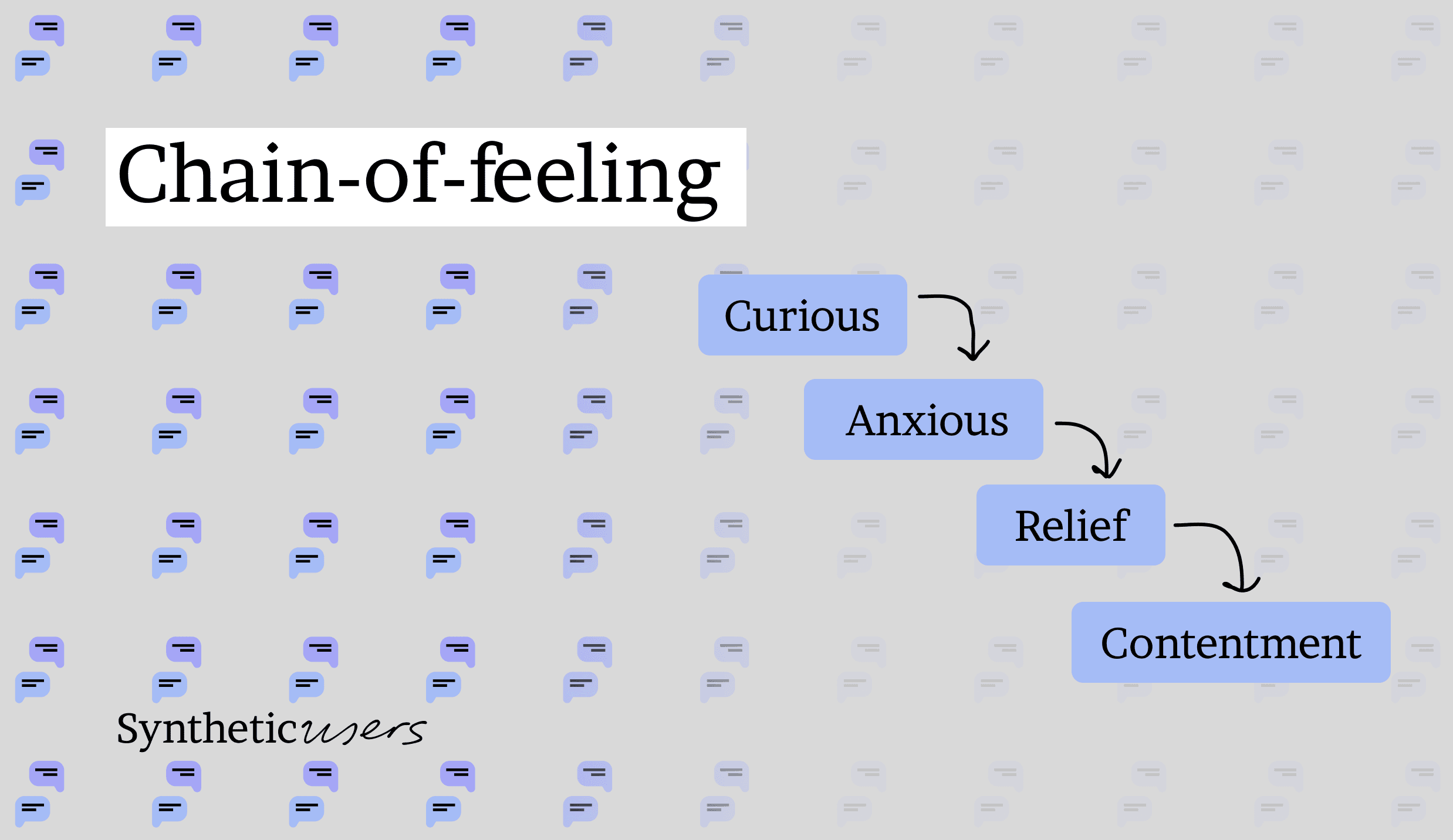
1. I start curious or uncertain.
2. I become slightly anxious if I can’t find a clear solution.
3. I get relief upon finding a direction.
4. I end with contentment once I feel the solution is good.
In an interaction with a Synthetic User, each step captures not only the “what” (chain-of-thought) but also the “how it feels” (chain-of-feeling). This helps produce more realistic and emotionally diverse behaviors that mimic how real users respond to frustration points, excitement, confusion, etc.
2. Why we came up with a Chain-of-Feeling?
1. Better Realism: Organic users’ behaviors are heavily influenced by how they feel at each moment in a workflow (e.g., frustration can cause users to abandon a task even if they could complete it with more time).
2. Personality Integration: Synthetic Users each have an OCEAN-based personality profile (Openness, Conscientiousness, Extraversion, Agreeableness, Neuroticism). We needed a mechanism to model how those traits alter emotional responses over time. A user high in Neuroticism might escalate frustration quicker, while a highly Agreeable user might maintain calm longer.
3. Better Insights: By incorporating emotional states into the chain of reasoning, we get a more “human-like” variety of responses, often revealing edge cases. This enriches your UX research and highlights potential improvements in product or service design.
3. Modeling the Chain-of-Feeling
1. Defining Emotional States and Dimensions
• We use Plutchik’s wheel of emotions. It’s the one with most scientific backing.
• We attach intensities or valences (e.g., scale of 1–5 for mild to intense).
2. Triggers and Transitions
• Triggers are events in the user’s journey: encountering an error message, discovering a new feature, facing a time constraint, etc.
• Transitions describe how the user moves from one emotional state to the next, informed by the user’s personality traits and the context. For example, a user with low Neuroticism might shift from mild anxiety back to curiosity quickly, while a high-Neuroticism user escalates from mild anxiety to strong frustration.
3. Incorporating Personality (OCEAN)
• Openness: More open users might respond to new designs with curiosity or excitement instead of confusion.
• Conscientiousness: Might drive perseverance in the face of frustration—leading them to stay longer before giving up.
• Extraversion: Could lead to positive affect more quickly, or a tendency to consult help sooner.
• Agreeableness: Might lead to self-blame or calmness instead of anger at the interface.
• Neuroticism: Might intensify negative emotions or cause them to linger.
4. Annotating Steps
• Each “step” the user takes can include a short emotional annotation. For example:
1. Thought: “I need to find the settings tab.”
Feeling: “Mild frustration (2/5) after not seeing it immediately on the screen.”
2. Thought: “I notice a hamburger menu, maybe it’s there.”
Feeling: “Slight relief (1/5) but still uncertain.”
3. Thought: “Yes, the settings are there. Let me open them.”
Feeling: “Neutral, trending to curious.”
4. Using the Chain-of-Feeling in UX Research
1. Scenario Simulation
• We run multiple Synthetic Users through the same concept. We collect the chain-of-feeling logs alongside decisions to see which personalities or emotional triggers lead to task success/failure, early drop-off, or dissatisfaction.
2. Identifying Pain Points and barriers
• We locate patterns where frustration spikes or confusion becomes prevalent. This helps us identify areas in the concept or design that might cause negative user experiences.
3. Concept Iterations
• We tweak the concept based on these identified emotional friction points, then we re-run the Synthetic Users to compare emotional states pre- and post-changes.
• If after a design fix the chain-of-feeling logs show fewer spikes in frustration for the same tasks, we might infer that real users will also have a smoother experience.
5. Summary of Key Points
• A chain-of-feeling mirrors the structure of a chain-of-thought but tracks emotional progressions.
• Each step includes both cognitive reasoning (“What am I thinking/doing?”) and emotional response (“How do I feel about it?”).
• OCEAN personality traits guide how emotions shift and how strongly they manifest.
• This framework yields richer, more human-like Synthetic User, unveiling friction points and user experience issues that purely rational or purely “thought-based” models might miss. As per our earlier point of Super Intelligence vs Human intelligence. Synthetic Users is all about Human Intelligence.
Damasio’s View: Emotions vs. Feelings
Emotions as Bodily States, Feelings as Mental Experiences. Emotions happen in the body first. Feelings are the mind’s interpretation of those emotions.
Applying This Distinction to Synthetic “Chain-of-Feeling”
When we say “chain-of-feeling” in the context of Synthetic Users, we’re primarily talking about the subjective experience side—i.e., feelings in Damasio’s sense. Of course, Synthetic Users do not have real physiological changes (like a racing heart), so we rely on simulated or “fictional” emotional states.
To be precise:
• We are not truly modeling bodily/physiological changes (which would be “emotions” in Damasio’s terms).
• We are modeling the subjective interpretation of states—the synthetic user’s personal, conscious experience of “frustration,” “relief,” “anger,” “curiosity,” etc.
Thus, from Damasio’s perspective, what we’re calling a “chain-of-feeling” is, strictly speaking, a “chain of felt or perceived emotional states.” Each entry in that chain is akin to: “I (the user) perceive I am tense or relieved, so I feel frustration or relief.”
Why This Matters. It makes for Synthetic Users that are closer to Organic Users
Because we’re only modeling subjective feelings (not actual physiological changes), we gain a human-like flavor of emotional diversity without needing to simulate the complexity of real biological processes.
Our novel approach pushes the boundaries of UX research, because understanding perceived frustration or perceived confusion is typically more relevant than the underlying hormonal changes that might occur in real humans.